Entries Tagged as ''

Take Advice From Do’ers Not Wind Talkers

If you read about successful people, as I like to do, you’ll find that downturns in the economy or rough times at the bank have very little to do with their success.  In fact, most don’t even mention the economy or banks when they discuss what’s needed to be successful.  Reading autobiographies of successful entrepreneurs will give you an inside look about what it really takes to make it.  I would strongly suggest you read success stories because they help you to mentally rise above the “ho-hum” of everyday problems.

There’s a popular myth we’ve all heard — “It takes money to make money”. William Nickerson, author of the most widely read do-it-yourself real estate book: “HOW I TURNED $1000 INTO A MILLION DOLLARS”, Simon and Schuster (1959), started investing with only $1000 saved from his telephone sales job.  Nickerson calculated back in 1980, using an inflation adjustment formula, it would take about $2500 to start out like he did.

Today, 25 years later, Nickerson’s calculation may need to be doubled or tripled again; however, Nickerson was always quick to tell anyone who would listen: It doesn’t have to be your money, nor does it even need to be cash! Knowing what to do - and how to invest wisely is far more important than having the money to invest.

A PLAN FOR CASH FLOW IS FIRST PRIORITY

When I began buying investment properties, there was no question in my mind whatsoever about where I might find some extra money if my properties didn’t provide enough cash flow.  The answer was clear to me the day I started — I couldn’t! Even though my cash down payments were quite small, it was all the money I had.  I knew very well there was nothing left in my bank account to make up for monthly cash flow shortages.  The only funds I would have to pay my mortgages and expenses would be the money I took in each month from my renters.  Obviously, buying properties this close to the belt is both challenging and exciting.  There is little room for buying errors as you might well imagine.  You definitely need your cash flow plan worked out before you sign the deal!

What I’m suggesting here — For most of us, it makes more sense to buy cash flow properties with uncertain futures than to acquire high potential properties without enough cash flow to operate them today.  Future potential is great — Don’t get me wrong, but it’s still “Pie in the Sky”! In my view, the top three reasons for owning and operating income properties are INCOME, INCOME and INCOME — Everything else must fall in behind.

ACQUIRE AS MANY UNITS AS YOUR DOWN PAYMENT WILL BUY

Almost every investor I know has paid too much for income property.  It happens more frequently when we first start out.  There is almost no defense against paying “too much” at least once or twice.  I’ve done it more times than I care to admit.  However, in my case, buying multiple unit fix-up properties allowed me to add value and improve the income stream more quickly than if I had overpaid for non-fixer type properties.  By fixing up properties I was able to recover from my buying errors much faster because I could raise rents.  The best education in the world for understanding real values and what the true expenses are - is learned very quickly buying and operating you own properties.  I’m not talking about a single house here.  That’s not quite enough action for me.  I’ve found that multiple fixer-uppers often don’t require any higher down payments than a single house - yet the cash flow potential is many times greater.  Often they come with seller financing to boot!

INEXPENSIVE RENTALS PROVIDE GREATER CASH FLOWS

One of the major parts of my personal investment strategy, which has paid big dividends over the years, has been to acquire lower end (affordable) rental units. These properties provide me with “eating money” or cash flow. They are my biggest source of income today.  Inexpensive rental units provide a much bigger (return) or “bang for the investor’s buck”. They’ve always been my number one cash flow providers. Obviously, these properties won’t normally sell as rapidly as higher grade rentals or single-family houses.  However, I’m a firm believer in first things first!

Share and Enjoy:
  • Digg
  • del.icio.us
  • Facebook
  • StumbleUpon
  • Google

Finding The Right Real Estate Agent

The best way to begin your search for Mr. or Mrs. Right is to visit the local real estate offices in the area where you plan to invest.  Ask the receptionist if she knows which agent sells the most apartment buildings or income properties. Get yourself introduced and tell the agent exactly what you’re trying to accomplish. The interview will be your opportunity to learn what the agent thinks he can do for you! 

But remember, he must know exactly what you want done in order to respond in a meaningful way.
Just like a budding romance, the first thing that has to work is chemistry!  It will do you no good in the long run to force yourself into working with an agent who disgusts you no matter how good you think he or she may be. Obnoxious agents are best left to service obnoxious house buyers since there’s no shortage or either one out there! I mention this because it’s very important to develop a relationship that can last a long time.  Lasting together is much easier when you like each other.

AGENT’S KNOWLEDGE ABOUT THE DEAL IS THE KEY

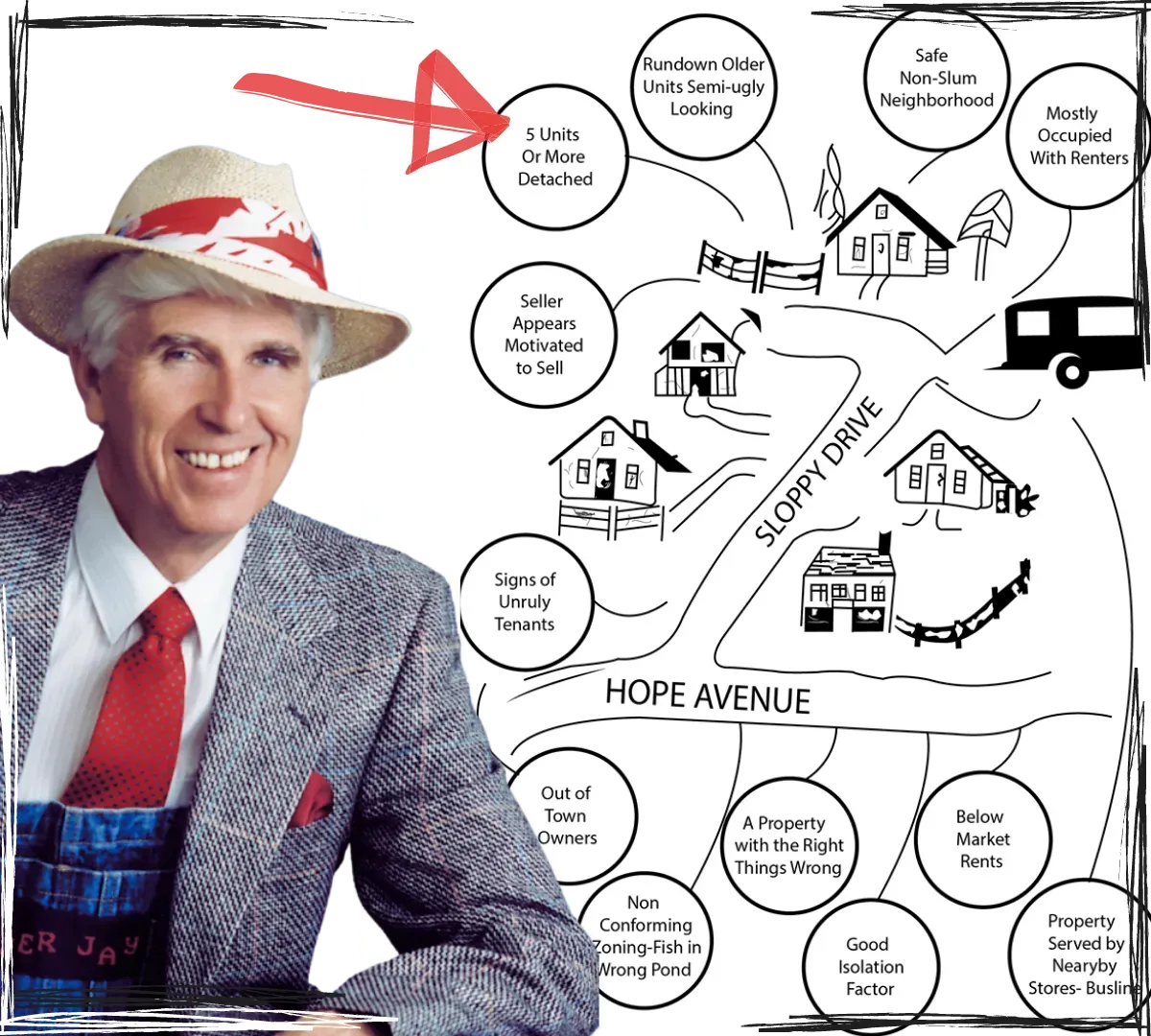
Try and be as specific as you can.  In my situation, I’m interested in “fixer-type”,  rundown properties.  I prefer detached houses on a single lot.  For example: 10 or 12 older houses on an acre of land would be something I’m very interested in.  I’m, also looking for properties with owner financing I’m particularly interested in properties that have several private notes or mortgages that I can assume.  Deferred maintenance (rundown),  problem tenants and properties that need major clean up are my specialty.  I wish to avoid new bank financing whenever possible and I’m trying to purchase properties with 10% cash down.  I can also add notes or other properties in trade.

This description about what I’m looking for and my special preferences should be enough to give most any agent a fairly decent idea of what I’m in the market for. Naturally, the price will have to fit the deal, but don’t ever forget; the asking price seldom has much to do with the final purchase price, particularly in the fixer business.

TRAINING YOUR PERSONAL AGENT PAYS OFF

A good agent will do “weeding out” for you automatically once he or she becomes accustomed to what you really want.  Fred always brings me everything I need for making an educated evaluation on each deal.  The information provided is normally A PROPERTY PROFILE, copies of EXISTING PROMISSORY NOTES and either a filled out INCOME PROPERTY ANALYSIS FORM (the kind in my fixer house book), at least the necessary data to fill one out.  He verifies rents, vacancies and liens.  This is valuable “time saving” work for an investor, yet it’s needed before any intelligent buying decision can be made. All this stuff takes time and it costs Fred money.  The only way he gets paid back is if I buy the property.

Fred don’t make a lot of dry runs. He knows what I want and determines quickly if a property has the right stuff. How did Fred get so smart?  How did he ever learn this detective business anyway?  When Fred and I started, we spent a lot of time discussing what I wanted! Investors must be very clear about which properties they will buy when one comes along; otherwise agents will attempt to show them everything.

NEVER SEND YOUR AGENT ON WILD GOOSE CHASES

Agents won’t hang around you if you’re just a LOOKY-LOO.  That’s a person who wants to see everything but nothing ever seems to meet his approval.  No agent worth his salt can afford that nonsense!  Fred works for me for one simple reason — It’s profitable!  He knows I can close fast if he does his job.  Fred’s job is to know exactly what I will buy.  He don’t call me about every property for sale in my town.  A good agent will immediately qualify the property to determine if it has potential.  Fred knows I don’t normally want deals where new bank financing is required.  He also knows I want sellers who will carry paper and that I rank small “leper-type” properties, like 4 to 6 houses on a single lot or a bunch of ugly rundown duplexes at the top of my buying list.  When he hears about these kinds of properties, he acts quickly!

Real estate agents are the EYES and EARS of the real estate business! 96% of all sales and trades involve licensed sales persons and their brokers.  It would be very foolish indeed to harbor any serious notions about excluding them from your investment plans.  The best thing you can do for yourself is to diligently begin searching for a good one.

Share and Enjoy:
  • Digg
  • del.icio.us
  • Facebook
  • StumbleUpon
  • Google

Fixing Houses Always Begins Outside

 Fixer properties should always be fixed outside before inside.  The reason: Potential customers (tenants & buyers) judge a property on the basis of what they see when they drive by.  Doing fix-up where the property is located on a main thoroughfare or a heavily traveled road—this strategy becomes even more important.  Always remember, the world judges almost everything on looks, ugly houses included.

STUDENT DON COLLINS SHARES HIS EXPERIENCES


PAINTING EXTERIOR

Painting changes the appearance of a property overnight. It’s important to do it first. Use off-white, cream or any light color on body of house. For trim, eave boards, windows, trim around doors and frames, can be a dark color like brown, maroon or charcoal for sharp appearance. Use medium grade exterior latex after scrapping (wire brush) any peeling paint. A latex primer coat may be needed on older wooden surfaces.

LAWN’S & PLANT’S

 Tenants and buyers like green grass and flowering plants. I’ve found that even watered weeds; mowed and trimmed, look enough like lawn to pass for lawn! Toss out some lawn seed to thicken the stuff! If there is no lawn, plant one and water several times each day while you’re working inside the house.  Also, plant a couple fast growing trees if none exist.  Fruitless mulberry or Modesto ash will do the trick.  Shrubs and bushes add a great deal of hominess.  Pyracanthas and flowering oleanders are fast growing and nearly childproof.  Even repeated relief visits by the neighbor dog packs won’t hinder their growth. Pyracanthas have stickers, which deter kids from plucking them up. They stay green and sprout colorful red berries “in season”.  Oleanders make good dividers and add privacy.  They grow faster than baby Dobermans and can survive under the affectionate care of most tenants.

WHITE PICKET FENCES 

 Picket fences add a truckload of street appeal to most any property. Street appeal is easy to convert to cash. Both renters and buyers are Impressed!  White Picket fences create the ultimate feeling of hominess.  I build them 36″ high, with pointed pickets!  Sharp points discourage high jumping for all but the very bravest kids. I use 4′ posts buried 12″ and cemented - 8′ apart! Use metal joist hangers to secure parallel 2 x 4’s - 12″ and 30″ off the ground. Lastly, nail on 1″ x 4″ cedar pickets, spaced 4″ apart - paint white.  Gates are optional.

SHUTTERS & WINDOW TRIM

Just like the old western movie sets - “What- people see is how they judge”.  Renters and buyers alike are generally impressed — Or they’re not as they’re getting out of their car!  The first 15 seconds is more important than the next 15 minutes.  Your house is not unlike a propped up movie set.  It must show very well from the front, so that’s where you “gussie it up”, right in the front where it shows.  Shutters, even those fake plastic ones add sizzle, especially if the windows on each end of the house are the same size. If not, window surround (trim) like 1″ x 6″ cedar boards around windows; paint in a trim color adds extra class for little cost.  Facia boards covering the rafter ends give a finished look to any house. Again, paint in the trim color.  Partially enclosing a front entrance porch or stoop often adds much to looks. Extending the roof over an uncovered porch and enclosing with pre-made 4 x 8 redwood lattice panels, painted two-tone can “spruce up” the appearance of a house with the blahs.

ROOFS

 If the street-side of the roof is worn and ugly, it seriously distracts from curb appeal! If my budget can stand it, I will likely have the street-side of the roof replaced. Leave the back till later and patch it for a while. Hardly anyone ever watches what goes down “out back”. If it’s out of sight, it’s out of mind — Nine times out of ten.

REAR YARD FENCES FOR PRIVACY

I like fences — Tenants and buyers like fences. You can rent average houses for 10% more if they have rear fences that will keep kids and dogs incarcerated.  Mothers understand the value when they first drive up to do business.  The biggest problem is cost - 6′ board fences are not cheap. If you don’t have the budget to do back yard fencing, wait until you do. But don’t rob front yard money under any circumstances. Back yards rank way below front yards and appearance.

Share and Enjoy:
  • Digg
  • del.icio.us
  • Facebook
  • StumbleUpon
  • Google

To Build Wealth You Must Stop The Leaks

I have long held that one of the most important reasons for investing and operating income-producing real estate is because you can enjoy maximum control over your investments. You alone may collect the income. It’s you alone who gets to keep the money, less expenses, from the properties every month. You decide who will live on your property, when to make improvements and when to raise the rents — Finally, it’s you who writes the checks and keeps control of all property expenses.

I can’t speak for others, but I like to invest my money in the kind of investment I can reach out and touch! Houses and small apartments fit the bill perfectly. I also like to invest my money where I’m the boss. My plan for making money is the only one I use. With my name on the deed when something goes haywire, I have all the control to immediately fix it. Most importantly, I don’t lose all my money when someone else goofs!

Obviously, no investment is 100% FAIL-PROOF. However, I have found that investment houses are about as close to fail-proof, as I need to be. Once I learned how to structure my purchases so that the mortgages would be paid off by my tenants over a long period of time, I effectively removed most of the downside risk to me. The highest risk is during the first 2 years of ownership. That’s when most marginal tenants move out and expenses are at their peak because of clean-up and fixing. After that, it’s much smoother sailing as rents begin to move up each year while the mortgage payments stay constant. Added cash flow automatically “locks in” greater safety.

When I compare owning income-producing houses with other common types of investing — I still like mine the best! Real estate has an excellent track record for as long as I’ve been around. It has it’s own tax shelter and, of course, my renters will pay off all my debts. All I have to do is hang on and make good management decisions. After my tenants finally payoff the mortgage debt, the money I get to keep every month far exceeds the dividends of any equivalent size investment I know of.
My good friend from Chipley, Florida, investor Jimmy Napier, says it best — “NEVER ALLOW ANYONE TO VOTE ON YOUR MONEY.” When you own income-producing real estate houses — And you collect all the rents, you’ve effectively stopped most investment leaks!

Share and Enjoy:
  • Digg
  • del.icio.us
  • Facebook
  • StumbleUpon
  • Google
Click Here to Join Fixer Jay's Blog!