Entries Tagged as ''

PROFITS COME FROM INVESTOR’S KNOWLEDGE

I get calls from investors almost daily asking me if it’s a good deal for them to purchase a house 20% under appraisal. Obviously, there’s no way I could know the answer! I generally ask them — What’s the price? They tell me $109,000. Next I ask — How much can you rent the place for? They say $750, they think. Then I ask — How much do comparable houses in the neighborhood rent for? They don ‘t know, but somewhere between $700 and $850, seems about right they say! Are there lots of $750 renters, I ask?
Don ‘t know’, they say!

It’s right about now when I tell them — You ain’t quite ready to do business just yet! You’ve got to get yourself prepared a little more before you stick you neck in a noose and can’t pull it back out. Mark Twain used to say it took him two weeks to prepare for an impromptu speech. I wouldn’t think buying houses and trying to make a profit would take anything less! Unprepared real estate investors are indeed like sheep marching toward the slaughterhouse. Perhaps a few will succeed on pure luck, but the odds are heavily stacked against them.

In the case of the $109.000 house, which supposedly is appraised for $136,000 or so, maybe it’s a good deal and maybe it’s not! Without more information and a little bit of homework, I don’t really know, for example — If all the other houses around it are selling for $100,000 or so, then what good is a 20% below appraisal price? That’s no bargain! If you live in a low income area like I do, where only 20% of the total renting population can pay $750 or more per month, you must ask yourself-– Will there be enough customers (renters) so the house will stay rented? You certainly don’t need a bunch of $750 rental houses without a matching supply of $750 renters. Buying at 20% under appraisal could still sink your ship if you “buy in” before you know a few answers!

Say they’re lucky enough to buy in with a 10% down payment for a non-owner occupied property, then there’s the matter of financing the other 90%! Fixed-rate mortgages for rental houses will always cost more than your personal residence when it comes to long-term financing. Many lenders have nothing to offer except variable interest rate mortgages for rental houses. But, let’s just assume we can find a fixed rate, 30-year mortgage at 7.5% for a rental property. Principal and interest will add up to a monthly payment of $685. That’s just the finance cost and as you might guess, we ain’t quite done with expenses yet.
No matter how tight you manage, and in this case you’re doing it for free, there’s still property taxes, insurance, maintenance like in painting and repairs when something breaks – plus the occasional “down time” when a tenant moves out. No matter how you slice it, or sometimes ignore it, the total expenses will still cost 30-35 cents out of every rent dollar that comes in! Right off the bat we have a glaring math problem here! The $685 mortgage payment gobbles up about 90% of the $750 income. Adding $90 to 30% should give you a pretty fair idea that something’s wacko! In this example, we would need another $160 every month just to break even while we’re managing the house for nothing!

PROFITS DEPEND ON KNOWING COSTS

Every investor must develop cost and value for his own investment area! It takes some time and effort, but it’s critical for estimating how much you can pay – and ultimately, whether you’ll end up with cash flow and profits! Tons of information about investment properties is handed out to potential buyers by selling agents and brokers, which don’t mean diddlysquat about bottom line results. In the business of profit making, you must focus on two important numbers. What will your customers pay for your product? And – what can you afford to pay (purchase price) to provide your product and still make a profit for yourself? You should not move forward (in my opinion) without the answers.

Determining the rents and values in order to build your gross rent multiplier chart comes from doing lots of grunt work. To learn rent values, pretend you’re a renter in search of housing. Call telephone numbers in the classified ads for different locations within your investment area. Drive out to see what $700 per month will buy you in a two-bedroom house or apartment. Do the same for $500, etc. Once you become familiar with different parts of your town, you’ll be able to read the prices in newspaper ads and have a pretty good idea about what the properties look like and how well they’re maintained.
Another important benefit that comes from actually checking out rentals and talking to people – you’ll begin to learn about locations where tenants at various rent levels choose to live. You’ll learn about the “hood” areas – and where the dopers hang out. Don’t let the age or condition of a property fool you here! Dopers will sometimes occupy newer buildings – and trashy properties can often be found in excellent rental locations. Many times, out of town owners will milk a property until it completely runs down.

PROPERTY VALUES ARE YOUR BUSINESS

It’s important to know what the majority of renters can afford to pay in your investment area. For example, in my town I rent many 2 bedroom, single bath, houses to young couples with a small child or two – also to seniors. Both these customers cannot afford rents over $750 per month. Knowing what my customers can afford helps dictate how I buy properties. Smart investors will study the marketplace in order to deliver the right product (affordable houses) to his customers. It’s important to remember - if my tenants can’t afford to pay for my houses – I can’t either! It would be very unwise to own a stable of houses renting for $900 per month if you lived in a town full of $750 renters. If the majority of renters in your area can easily afford your houses, it’s much easier to keep them occupied and profitable.
Learning about property values in your investment area can be accomplished much easier with the help of a knowledgeable agent or broker. Obviously, they don’t have time for teaching greenhorns and looky-loos. They need to earn commissions to buy groceries and beer for their babies. If you’re not quite ready to buy a property just yet, you’ll need to polish up on your acting and pretend you are, if you expect much help from agents.

ADDING VALUE WORKS ANYWHERE – ANYTIME

There are many different investment strategies for making money in real estate, but almost all of them depend on future appreciation for the lion’s share of the profit making! Appreciation is worth big bucks when you’re fortunate enough to own properties during inflationary times! However, when you own real estate during a poor economy (like my state of California is now), you need a technique that makes money without appreciation if you intend to stay in’ business very long. Let me tell you about the strategy I use where my profits are not totally dependent on a appreciate or even a growing economy. It’s called, “The Add-on Value Plan”!

In order to make a property more valuable, the property must have the potential for improvement. Many properties are for sale that don’t have potential for adding on value. When you acquire these kind of properties, all you can do is keep them operating efficiently, collect the most income you can and hope the value increases some day. In other words, after you buy the property, you’re more or less held hostage by the economy. If it’s good, you’ll probably do alright! If it’s in the toilet, like my state is right now, chances are you’ll be in the toilet too – all things being equal.

Investing in this manner is not nearly as profitable nor as safe as using my add-on value strategy! There are many reasons why this is so, but the biggest reason is because you can achieve almost total control over what happens with the property financially. This is made possible by purchasing the right property to begin with. Remember what I said – YOU MUST ACQUIRE PROPERTIES WITH THE POTENTIAL TO ADD ON VALUE. Rundown properties with fix-up potential — And properties that are poorly managed are the best candidates for adding value quickly!

LESS COMPETITION MEANS BETTER BARGAINS

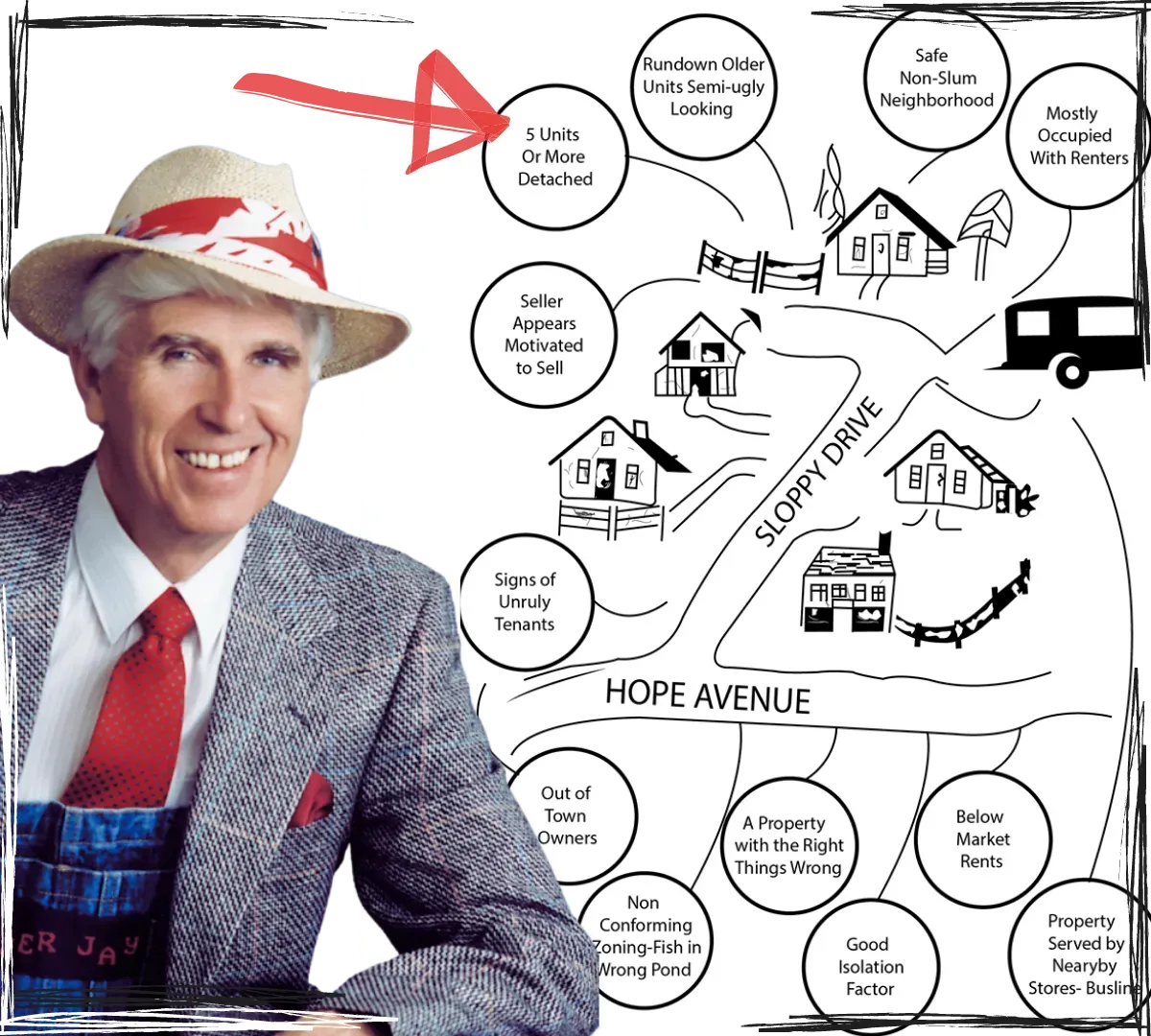
When you set your sights to acquire rundown properties or poorly managed real estate, you are automatically in the “Profit-Making Mode” right from the start! The reason for this is because moat buyers are turned-off by properties that are ugly or rundown and have management problems. This means there’s much less competition for these kind of investments. Naturally less competition allows you to control the purchase price and terms, especially when no one else is making offers when you are! There have been many occasions where my offer was the only offer to purchase a rundown property. Obviously, sellers are receptive to any reasonable offer under these circumstances if they are serious about ridding themselves of their problems.

The following profit: opportunities and conditions exist at nearly all problem properties:

1. LOW PURCHASE PRICE – 20-40% BELOW POTENTIAL MARKET VALUE.
2. MINIMUM CASH DOWN PAYMENT REQUIRED IS NORMAL.
3. LIBERAL SELLER FINANCING FOR ALL OR MOST OF THE MORTGAGE DEBT.
4. PROPERTIES LIKELY TO BE UNDER-PERFORMING (LOW RENTS).
5. PROPERTIES HAVE EXCESSIVE OPERATING EXPENSES.
6. QUITE OFTEN PROPERTIES OCCUPIED BY MARGINAL TENANTS WHO CAN BE REMOVED FOR  HIGHER RENT PAYERS AFTER PROPERTY FIXED-UP

WHEN YOU FIND A WINNER – ACT QUICKLY

The first thing to do is not panic! My kind of properties are almost always available –­You simply haven’t discovered them yet. Finding the right properties, meaning the kind that will produce monthly cash flow and long-term profits, is one of the most important skills you must develop to enjoy any success in this business! Remember, if this was, too easy – everybody would be doing it and they’d all be rich! Finding properties that will earn respectable profits is one of the biggest challenges for every investor regardless of how many properties might be for sale in his buying area.

You must always keep in mind – finding profitable deals is our goal — Not finding lots of deals! Pattern your buying methods after that old Hills Brothers coffee TV commercial a few years back. “90% of all the world’s coffee beans are rejected by Hills buyers –­They’re sold to the other guys.” The truth is, about that same percentage should apply to buying the right kind of real estate unless you’re only doing this stuff as a hobby. Qual­ity deals are the ones that make money. Do not substitute profits for volume. It makes very little sense to hurry up and buy a loser!

LOOKING WHERE THE CROWD DON’T GO

People constantly ask me how do you find these kind of properties? “Diamonds in the Rough”, some call them! The most common alibi I hear is — There’s no properties in my home town like you write about! With very few exceptions, I must disagree. The properties are there! You simply haven’t found them yet. There are some reasons why you haven’t; however, I’ve found most folks haven’t been looking for them. Most investors I know about do the tradi­tional kind of searching for properties. If they wish to be apartment owners, they tend to look at traditional apartment buildings. Single house people generally drive thru the “Burbs” in search of prey. Hardly anyone is screwy enough to buy slaughterhouses or an old motor lodge. My suggestion is to broaden your vision a bit. After all, “non-traditional properties” are lots more fun – as well as more profitable.

If you’re dead-bang serious about real estate investing like I am – then you should always make it a daily habit to read (check out) the classified ads in your local newspaper where you buy properties. My best-classified purchase was eleven fixer houses on Haywood Avenue. The property was listed under “Income Property For Sale”. I’ve written about my Haywood houses in my best-selling book, INVESTING IN FIXER-UPPERS; however in case you missed the details, let me simply say, Haywood made me $150,000 profit and $1000 monthly income for only one full summer’s worth of work and clean-up.

QUICK ACTION EARNED ME THE MONEY

Many investors do not adequately prepare themselves for a quick response. Simply stated, they don’t realize when they’re standing directly on top of a gold mine. At Haywood I was more than ready. Indeed, it was a gold mine – and I knew it the minute I saw it! Needless ~o say, I’m like most every other buyer. I’m aware that sellers will likely pad their advertised selling prices knowing full well that during negotiations they’ll take a little bit less. But here’s the deal folks — When you’ve done your homework and you already know what price you can pay based on the profits you expect to earn if your offer gets approved, then why play games with the seller and gamble on losing the deal! Your main goal should not be to save a few dollars on the purchase price or attempt to alter reason­able terms, but rather your main concern should be — Will this property be a winner for me based on the offer I’m submitting to purchase it?

It’s important when you make a full price offer like I did on Haywood to limit the seller’s time to accept. You don’t -want your offer “shopped around” or in competition with other buyers. One or two days is generally enough time with fax machines available everywhere. Full price offers always make agents and their selling clients extremely nervous! Both feel that the price they set was too cheap. That’s an important reason to make them sign your offer quickly. Don’t give them any extra time to think!

The thing I remember most about my Haywood property is how quickly I responded to the classified ad. I called the listing real estate agent at home on a weekend. The ad ran Saturday morning and I handed him my written offer on Sunday.

Let me emphasize the speed of this deal. This is a very important part! When I called the agent at home, he told me the property address. I drove out to see it immediately. I already knew the general location was good and after a quick look at the houses, I raced back to my desk and scribbled out my offer. The classified ad was written up quite ex­plicitly regarding the owner’s terms for selling. He specified the price, a modest down payment and that he was willing to carry back financing for 15 years at reasonable interest. Everything I wanted was spelled out in the ad. Needless to say, I was more than “hot to trot”.

Click Here to Join Fixer Jay's Blog!