Entries Tagged as ''

Changing Careers – Keep the Money

Think about this for a moment! When I buy an Income property for $40,000 less than its true market value using my investment knowledge, how much tax do you suppose I’ll have to pay on the $40,000 I’ve just earned using my buying skills? No matter how you do the math, the answer is zip-like in none! Now think about the same $40,000 that you earned last year at the factory in wages. Assume you’re a family of four. I’d bet that when we add up the state, federal and social security taxes withheld from your earnings you’ll be lucky to take home $28,000 for ~ whole year’s worth of work.


You’re talking about giving up or losing $1,000 every month. I’ll earn the same $40,000, but the difference is I’ll end up keeping it all and it didn’t take me a year to earn it.

The difference is I’ll end up keeping it all

Remember we’re only talking about one small deal here. This stuff gets real exciting when you start thinking about several deals going on at the same time.


If you follow my reasoning, you’ll under­stand that the quickest way to become a suc­cessful investor is not so much dependent on how much money you have, but rather skill­fully using all the dollars you earn to advance yourself. The idea is to quickly build up your money-making assets and substitute your tax battered wages with cash flow earnings from your Investment houses. Living off tax sheltered rents allows you to legally beat the tax man and keep all your earnings to build your own wealth

.

Changing careers like I did is not for everyone, nor should it be. Folks have dif­ferent goals and dreams. For those who wish a change in their every-day life or have decided what they do now to earn a living might be temporary or shaky, allow me to give you a few insights into the world of a full-time real estate investor. I’m qualified be­cause I am one and I’ve made some serious money doing it.


I decided to buy older houses and small apartments that needed fixing up. My rea­soning was: I can do much of the work myself. Plus, I can buy them for much less cash down because there are fewer serious buyers for unsightly distress-type properties. I also thought that once fixed and cleaned up with a new paint job, older rental houses would command about the same rents as equivalent-sized newer houses. The same thing is true with the older rundown apart­ments, although I’ve always favored houses because tenants rent houses quicker than apartments.


Once I decided where I wanted my plan to take me and are choosing inexpensive fix-up houses as the vehicle to get me there, I con­sidered how much risk would be involved. Shopping centers are high risk properties. Land speculation is more like gamblin” Bare land can go for years without any income or payback. Special use buildings like airport hangers, bowling alleys, auto factories and resorts can sink an investor quickly if the tenant moves out. You limit yourself to a very specialized group of tenants when you own “special use” properties. It’s dangerous for beginners who normally don’t have holding power (extra cash reserves).


That’s exactly what new investors need­ non-existent risk.

I knew from the beginning I could not stand many vacancies. Too much risk of any sort was not what I wanted or needed.


It’s very important to stay within your means financially and to acquire the type of properties you can personally handle your­self. If you do that, you can almost write off the risk factor. Inexpensive rental houses and small apartment buildings will always have long waiting lists of qualified tenants if you keep the properties looking attractive and in good repair.


The single most dangerous roadblock facing every career-changer is procrastina­tion. There is no doubt that many folks with the bet intentions and even a good workable plan will procrastinate forever. Look around you. How many people change careers versus how many simply talk about it? Don’t let the odds hold you back. Remember, financial success is not about having good luck. It’s about having a good workable plan and you’re working that plan.

SHOW TENANT HOUSE HE CAN AFFORD

Every time I attend a “How to Get Rich Quick In Real Estate” seminar, I’m told by some speaker In a dark blue suit that I should always rent my properties to “blue collar” tenants with middle class jobs who have unblemished credit ratings. There is one exception, they claim! It’s OK to rent to senior citizens with an adequate pension income in addition to their regular monthly social security checks.
I suppose that’s good advice, but I also suspect the speaker doesn’t depend very much on rental income to buy groceries like I do. Obviously, the questions I have, along with thousands of other small-time landlords are; what happens If I can’t find tenants in those two categories? What If my properties don’t attract blue-collar workers or senior citizens? The last seminar leader I tested those questions on tried to avoid me at first. When I kept on asking, he sort of turned the other way and his face got real red and twisted – like a man suffering from a chronic gas disorder.
Most Renters Pay their Rent
Contrary to the landlord-tenant “horror stories” we’ve all heard about, most tenants who agree to rent your property will also pay their rent. This fact of life eliminates about 95 percent of your collection worries. Trust me on this I can prove it! The big problems are caused by the remaining five percent who can literally destroy your Iife! It’s the old story abut the rotten apple in the barrel and unfortunately, “destroy your life” is not too strong a term for what can easily happen when innocent, but “dummy” landlords do battle with “ring-wise” deadbeats.
Many Landlords Help Tenants Go Wrong
Have you ever made the rounds to see the model homes when developers present their annual home tours? All the houses are “decked out” with expensive furnishings and yards are immaculately landscaped. If you’re like me and you start the tour looking at houses selling for $75,000 and end up viewing those that cost $350,000 – It warps your value system. Your taste is suddenly “light years” ahead of your financial capacity.
Most folks, who do these, tours like me, are rational thinking people. Their minds can adjust to their pocketbook without too much difficulty, but consider what would happen without this adjustment. The results would be similar to a child at the dinner table whose eyes are bigger than his stomach. Without some kind at help or restrictions, he’ll always take more food than he can possibly eat!
A Tenant Problem Is Your Problem
Landlords need to use this logic when they rent their properties: Never show $800 houses to renters who are not qualified to pay a nickel more than $400. Naturally they’ll want the house they can’t afford. You must always quality the tenants ability to pay rent first. That will dictate the property you show them. Remember the models! If you show an $800 unit to a $400 tenant, I’ll guarantee you’ll either lose him as a customer or he’ll attempt to stretch beyond his financial capacity by agreeing to rent your $800 house. It he succeeds, as many do – you’ll be the one who has a problem – and you’ll also be the one to blame!
Many lower income tenants need help with their finances. Some have great difficulty working out a balanced budget for them. Younger couples are especially overly optimistic about how much rent they can afford to pay. It’s up to you as a landlord-owner to determine how much gross income is needed to pay the rent you charge. I’ve found that most well are tenants would be willing to sign my rental contract for a suite at the Hyatt Regency. The problem is they can’t pay the rent. When that happens, I’ve got a problem too.
Never forget: rent money is like handcuffs between landlords and tenants. It’s the common bond! ” A tenant has a problem paying rent, the landlord has .the problem too!
When you begin to think of rental houses as a business venture rather than simply investing in real estate, it will open your mind to a whole new world of opportunity. The rules at business will help you immensely as an investor-owner of rental properties.

LOOKS ARE WORTH BIG MONEY

Fixing for looks is every bit as important as fixing the toilet or the roof!


It’s important to understand that rent and buy decisions are often made in a matter of seconds by folks whizzing by the property in automobiles at 30 miles an hour. The first look and the first impression count for everything. If your property doesn’t generate positive vibrations on that first peek, you can forget the brand new carpets you installed inside.


” … that’s where the fix-up battle is won or lost. “


Tenants and buyers alike will judge your house exactly the same way they judge a book, by its cover! Knowing this fact about our customers can be worth thousands of dollars to you if you’ll apply it to your own fix-up strategy. It’s for this reason that I constantly instruct my readers to concentrate their main efforts on fixing what shows. Create good looks before anything else you do because that’s where the fix-up battle is won or lost.


Folks are always fascinated by my “foo-foo” beautification techniques. “Foo-foo” is my term for cosmetic fix-up or gingerbread. The primary goal is to upgrade the looks. Webster’s Dictionary defines cosmetic as correcting defects or to make beautiful. In some cases my techniques might stretch Webster’s definition a bit, but on balance, most folks agree: foo-foo techniques really do make ugly houses more pleasing to look at.


All of my rental houses and apartment units have been painted and cleaned up many times. Maintenance and repair expenses do very little to increase the value of any property. Painting and up-keep are merely costs of doing business. On the other hand, well-maintained plants, trees and lawns, along with my white picket fences and decorative front porches, do add some permanent value to the properties. Adding value should be your primary goal as a fixer.


Picket fencing can return $10 for every one dollar spent. Tenants will always pay more for fencing because fences add privacy. Rear yards are converted to more usable space. Cook-outs, nude tanning, wading pools, clothes lines, storage and a place to keep Fido are some of the backyard uses that tenants are willing to pay extra to have.


Front yard fencing is decorative or foo-foo. This type of fencing is not meant to be useful. White picket fences surrounding the front lawns of older houses give them a homey look. Quite often, when I show houses to prospective customers, the first words out of their mouth when they see the property, “Oh, it’s lovely, I just adore your white picket fence.” Remember, they haven’t even set foot on the property. They’re still in the car looking.


“Foo-foo creates the right look … “


Front yard fences are easy to build. I use regular 4×4 posts, treated with a preservative. Posts are set in concrete on 8-foot centers around the front yard. Leave access openings for sidewalks or entrance ways. Gates aren’t needed. My two construction methods are to build them with 3 rails (1 ‘x4′ horizontal fir boards) or for pickets I install 2×4 rails between the posts, attached with metal joint hangers horizontally. I then add pickets (1×4 fir boards) spaced every 4 inches vertically, nailed to the 2×4 rails. Fences are 36″ high for either type.


Exterior painting is among the highest ranking outdoor improvements because it can quickly and inexpensively change the looks and property image. For older houses with less than perfect exteriors, a light base color, such as off-white or beige, is recom­mended. Use a darker match color for the wood trim, facia boards, window surround and porches. On stucco houses, use the base color and a darker trim color for the woodwork. Painting is a very effective foo-foo technique because it covers up so many imperfections. In terms of payback, a new paint job can tack on 20 percent more value to a medium price house and sometimes double the price of a cheap one.

LANDLORD SKILLS PUT OWNERS IN CONTROL

Most new investors seriously underesti­mate how important it is to learn land­lording skills. Many so-called “Professional Property Managers” suffer from the same affliction. However, I can forgive them be­cause they’re simply working for fees with little prospect of ever becoming wealthy. We investors, on the other hand, have high hopes of becoming wealthy or at least as well off as our neighbor down the street with the Mercedes.


Landlording skills improve your income. Owning rental properties that produce income is without question a very profitable and worthwhile achievement. Most folks who buy properties and stick with it end up a whole lot richer than those who don’t. I’m a good example of this, but I must tell you, there is definitely a catch to owning rental properties.


The catch is if you do not quickly learn how to operate your rentals and handle the tenants who live inside them; you’ll think a lot more about suicide than counting your money. Getting rich is a very strong motiva­tion and will certainly carry you through some rough times. But, tenants who don’t play by our rules can have a devastating effect on our bank account as well as your quality of life as an investor.


I don’t mean to scare the daylights out of you, particularly if you’re just starting out. But, I do wish to call your attention to a very important function of property owner­ship that often receives hardly any attention. That’s because it’s not a very exciting part of investing. In fact, it’s the part of ownership that turns many would-be investors off.


” .. .it’s the dull part of ownership. “

Landlording and managing your proper­ties is very important. I’ll certainly agree with anyone, it’s the dull part of ownership. Yet it’s a path that must be traveled on your way to the gold mine. I often refer to property man­agement, including people management, as the 10 percent part of ownership that’s nec­essary in order to receive the benefits from the other 90 percent. The 10 percent figure I use comes from the amount I charged (10 percent of the gross rents) when I used to manage properties for others.


The first rule of good landlording is to treat it exactly like you would any other well run business. Managing your property is a business and the tenants are your customers. It’s your job as a landlord to provide the best product (houses) and the best possible ser­vice you can.


Offer your customer the best value in the rental business. That means a clan house or apartment, priced ideally at $10 to $20 below the competition. This is enough to swing many deals your way.


How can you tell if you’re $10 to $20 below the competition? The best way is to study your local classified ads. Then drive out and see what your competition is offering at comparable rents. Adjust yours up or down according to what you observe.


You will hear that deadbeat tenants know all the rules, which enable them to stay in your property month after month without paying any rent. Sometimes the storyteller will say this is so because the tenant has minor children and receives welfare or some other assistance.


Offer your customer the best value.

This is giving far too much credit to the tenant for being street-savvy and knowledge­able. But, chances are the tenant’s success is much more likely attributable to a dumb landlord. Seldom will any tenant stay very long in my property if he or she doesn’t pay rents. After you’ve done a few evictions your­self and learned what papers to file in a timely manner, you’ll quickly build enough confidence so that horror stories won’t happen at your properties. Again, I’ll repeat, know-how is the difference between owners who operate their rental properties successfully and the ones who are simply hoping for the best.

INVESTING WHEN YOU’RE CASH POOR

The most common investor question is: how can I buy real estate without much cash? The answer is simple. It’s the execution that gets a bit more difficult. If you don’t have money to buy a property, ask yourself: what do I have? For the majority of beginning investors, the only answer possible is, I have myself and I’m willing to work hard and learn. If that’s true, , can help you. You can acquire real estate without your own money but you must contribute something else in its place.

The something else can be your own personal efforts. That means your physical work contribution and educating yourself learning how to invest. I can help you with this because that’s exactly the way I started out myself.

” … ask yourself, what do I have?”

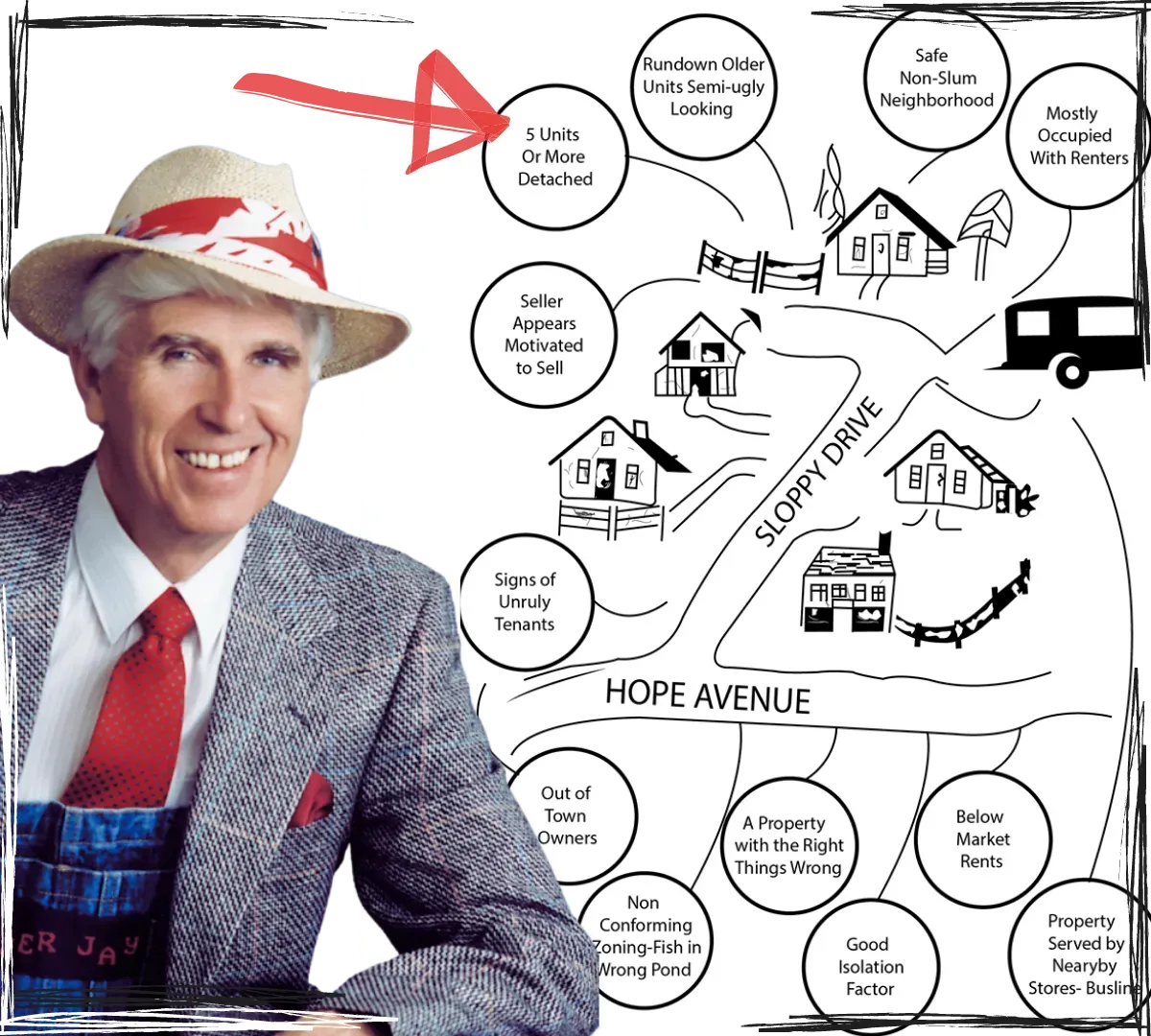
It’s important to position yourself to make money. For “hands on” type investors like myself, , have long held the notion that the best type of real estate to buy, when you are just starting out, is something between run­down and ugly and a complete “Junker.” The degree of run-down or ugliness will be mostly dependent upon how brave you are. The braver you can be the better off you’ll be with your first several acquisitions.


Ugly property buyers can always get the best terms. Sellers of these kinds of properties are not in a position to be picky about who they sell to. They can’t play “hard ball” with the price and terms like owners of higher quality, nicer looking properties. The reason is that 95 percent of all potential buyers are “turned off” by the run-down condition and ugliness. Consequently, lack of buyer competition will greatly limit the owner’s ability to sell.


This means you can almost always buy these properties for much less cash up front. Also, it’s likely the seller will be forced to accept much weaker terms. Lower equity payments and carry-back notes are common.


Many of these deals can be 100 percent owner financed. Also, ugly, Junker type properties are generally older properties. Many of them no longer have conventional mortgages like bank loans or savings and loan mortgages to payoff. When they do, they are often low balance loans with good interest rates and assumable to new buyers. For beginner investors, owner financing is the kind you want.


Properties where the owners will carry back the low interest financing are the kind of transactions that allow you to buy real estate with minimum cash down payments and still be able to get cash flow. Bank financing’ with higher interest rates or the variable rate mortgages are not the kind you want.


An important reason to start out with this type of property is it’s a good experiment for you. It provides you with an opportunity to learn what you can and cannot do. If you purchase a run-down house or small apartment building that’s an existing eyesore when you buy it, ask yourself this Question: How can I possibly make it worse? Even with very limited handyman skills, your efforts are still quickly to make some worth­while improvements. If you don’t do things exactly right the first time, so what! Who cares? No one but you will even notice. Simply do it over again until you get it right.


Doing ordinary clean-up is likely to result in a major upgrading. Most certainly it will improve the looks. When you tackle the more sophisticated improvements or repairs, take your time. Read a book or two and look at the how-to pictures. I promise, you’ll be pleasantly surprised to find out how many things you can really do by yourself.


Another important reason for buying run­down ugly houses is that you can add-on value very Quickly to these types of prop­erties. What this really means is that you will be able to buy cheap and sell for a profit in the shortest possible amount of time. You can also increase rents and develop a positive monthly cash flow much more rapidly with these properties, unlike buying pride of ownership properties at top market prices where your only chance for profit is waiting for inflation or appreciation. With fix-up properties you can force the value to go up by your own hand. Upgrading the property automatically increases the value. You don’t need to wait nearly so long to make money.

Click Here to Join Fixer Jay's Blog!