Buying real estate can be easy as pie - but becoming financially independent doing it is another story! To begin with, many wanna-be investors simply don’t understand where profits come from and what must be done to produce them. Many are of the opinion that timing and tough negotiating are the most important ingredients for making real estate millionaires! Purchase good properties in an appreciating market and you can’t go wrong, they say — That’s all there is to it!
PLAYING THE APPRECIATION GAME
The biggest problem for real estate investors who bet the ranch on appreciation is clear! What if there is none? Worse yet, what happens if property values drop? Real estate is a cyclical business. Prices and values go up and down! Betting on short-range appreciation is like shooting craps — You can sometimes double your money overnight, but you can lose the whole shootin’ match just about as quickly. Substitute “stock market” for real estate investing and you’ll see what I mean!
Reaping the benefits of appreciation without being on a rigid time schedule is by far a much safer strategy. Real estate almost always increases in value over time. For example: A 3 bedroom, single bath house in Sacramento, California cost $20,000 brand spanking new in 1968. It reached a high value mark of $181,000 in 1992, then dropped back to $160,000 in 1994. For short-term profit investors, selling between 1994 and 1999 was not a profitable strategy! However, true to form, when the five year down turn ended, prices shot skyward again! The amazing fact is that since the house was built, 40 years ago, its average value has increased more than $7000 every year.
APPRECIATION IS A BONUS FOR INVESTING
Appreciation should be the wealth builder’s helper, not the whole program! If you view it as a bonus or the gravy, then you don’t have to worry about the short-term up and down cycles. Instead, you can concentrate on how the serious long-term money is made. To start with, you need to understand that most wealthy real estate investors purchase lots more property than they sell! Selling properties, especially when you’re just starting out is a lot like digging a big hole and filling it back in! The reason for this is because the very minute you sell a property, your investment vehicle stops earning money. Worse yet, any gains or profits you might make are immediately exposed to the tax-man. Obviously, paying taxes and building wealth don’t work too well together.
COMPOUNDING IS THE BIGGEST WEALTH BUILDER
The power of compounding comes from leaving your investment alone! In other words, if it’ money in the bank, leave it there - don’t touch it! If it happens to be four rental houses, don’t sell them for a short-term gain. I will assure you - the short-term profits you take now will never be enough to make up what you’ll lose in the long run if you break up the compounding cycle
Compounding real estate equities works exactly the same way it does putting money in your bank account, only better. That’s because you can use a tool called LEVERAGE to speed up the money-making process. We’ll talk more about leverage in a bit, but first I want you to grasp just how powerful a force compounding really is!
Compounding means earning interest on both the principal amount and on the accruing interest. As it keeps adding on to itself over time, the results are simply astonishing! Most wealth builders are amazed to discover how quickly money multiplies. The following example serves to illustrate the power of compounding. Here’s how it works:
Let’s say you were to invest $1000 per month in your bank account for 20 years, without drawing any money out. Let’s assume you are earning 12% compound interest on your account. Did you know that would be enough to make you very close to a millionaire! It’s true — You would have $989,255 in your bank account by the end of 20 years.
$1000 per month might sound like a ton of money if you’re just barely making ends meet. But, $12,000 a year is not really a big pot anymore. Many folks have mortgage payments on their house twice that amount and monthly vehicle expenses that often equal it.
How is in the world can just 20 years of saving $12,000 a year make anyone a millionaire, you ask? After all, 20 years times $12,000is only $240,000. Where does all the extra money come? The answer my friend – it comes from the compounding — And, all you have to is leave it in the bank to continue earning with your monthly payments. In 20 years the interest alone adds up to $749,255. Obviously, this compounding is upper powerful stuff — And the real beauty of it is it can do a whole lot more for you if you’ll invest the same amount of money in leveraged real estate.
LEVERAGE ALLOWS YOU TO SOAR WITH THE EAGLES
Safe leverage can make you wealthy faster than any tool in your money-making kit. The idea is to borrow as much money as you can to put with your own small down payment (sometimes none) to purchase income-producing properties, which you will own and control 100%. For example, 90% leverage is where you would purchase a $100,000 building, using a $10,000 down payment and signing a $90,000 promissory note for the balance. If the property earns $10,000 annual rents, that means the return on your down payment is 100%! The problem is - that can be both good or bad. If expenses are $4000 and the mortgage payments are $7000, you’ll be earning 100%, but still losing your shirt!
Leverage is a double-edge sword! Safe leverage is the kind you want! In this particular example, if you can increase rents to $12,000 or negotiate a mortgage that costs only 5000 annually - you’ll earn a $1000 on your $10.000 investment. 10% cash flow with 90% leverage is a very respectable return. The key to making this strategy work extremely well is to add value and increase the income! By doing this, you’ll reduce high leverage (90%) down to safe leverage without waiting for appreciation to help. You’re in control!
FORCED APPRECIATION PUTS YOU IN CONTROL
Appreciation or inflation comes in 2 different flavors! First, there’s the kind that comes from natural causes. Everyone gets it automatically if they happen to own properties in an area where it’s happening. Sometimes it’s 2% a year, but I’ve seen appreciation jump to 25% for a short period of time. I’ve even watched properties double in price within a two or three year period of time. The problem with this natural appreciation is that there’s no guarantee it will happen! And of course, that’s why I recommend you treat it like a bonus or the extra gravy. Don’t build your investment plan on the basis of anticipated appreciation - just be ready to take your bows when it comes.
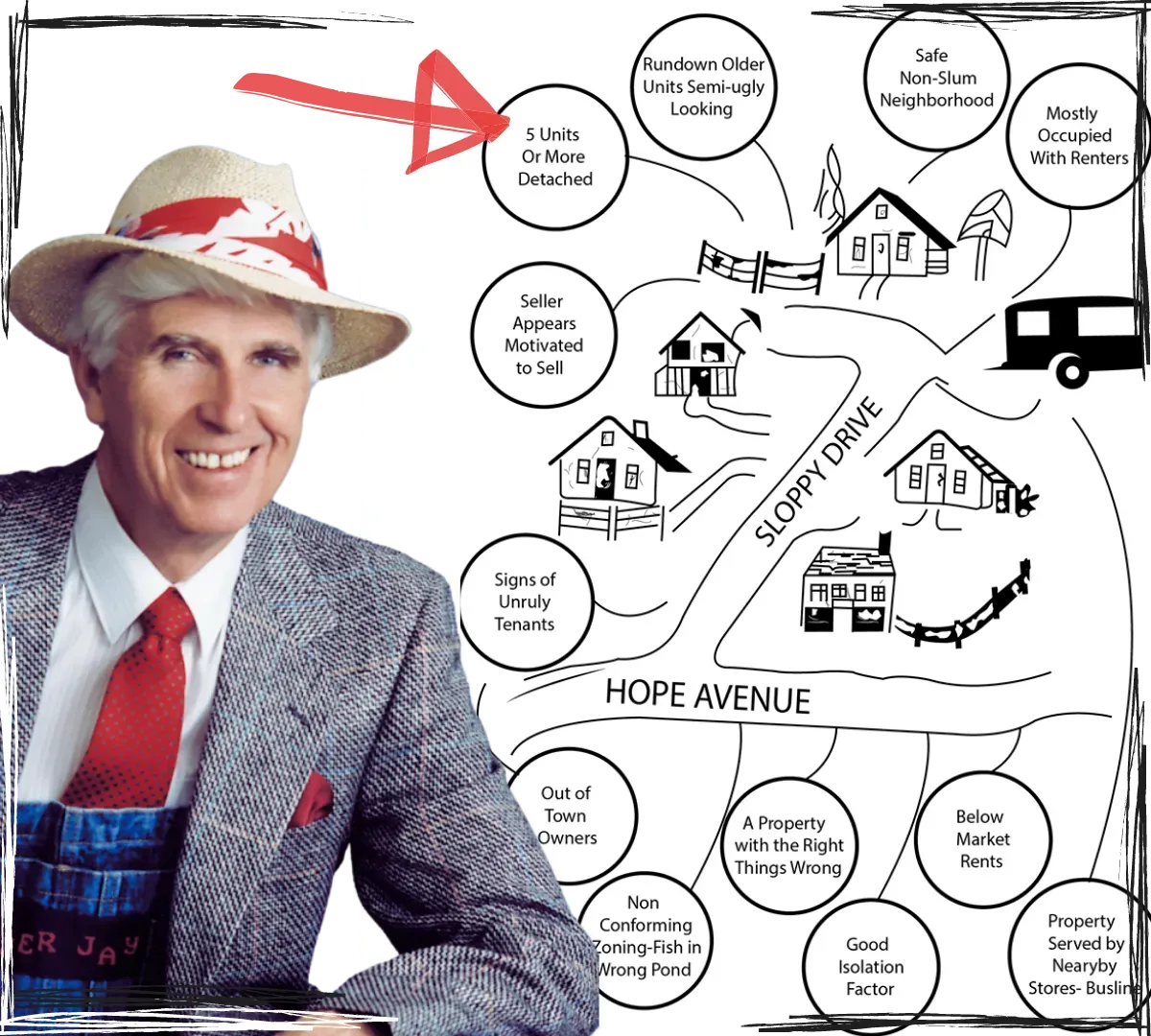
FORCED APPRECIATION is my specialty and you certainly can bet the ranch on it. The reason is because the investor can control it almost 100%. When I buy rundown ugly houses to fix up, I force them to appreciate in value. The higher value comes because I turn the ugly houses or apartments into nice units where good paying tenants will choose to live. My goal is to double the property value and increase the rental income by 50% in a period of 24 months. When property values double and 50% rent increases begin to compound. it won’t take long before you can add a couple extra zeros to your net worth, believe me!
One of the biggest reasons so many inexperienced “Mom & Pop” investors flop is because they invest in looks rather than the books (FINANCIAL DETAILS). If I could somehow wave a magic wand and turn every beginner investor into a little beady-eyed, tight-wad accountant for about a month or so before he was allowed to buy real estate - chances are he’d end up buying ugly houses as I suggest. But, he’d also have cash flow! Circle this sentence for future reference — Ugly houses are a walk in the park compared to hemorrhaging bank account. If you have experience, you know what I mean!
KILLING THE GOLDEN GOOSE
Disturbing the cycle in the early years will cost you dearly. For example: At the end of year 2 in our 20 year investment plan example the accumulated amount of principal and interest earnings would be approximately $27,000. If you were to take out (as in sell) or borrow $10,000 of that amount, the result would be a $230.000 loss at the end of year 20. Your accumulated total would be reduced to $757,860 because you took out $10,000 in the early years of compounding.
In later years as compounding builds the account and the dollar amounts get bigger, $10,000 will be insignificant in terms of slowing down the earning power. Consider investment year 17. The account balance would be $661,300 - it will grow to $757,800 by year 18. If you were to borrow $10,000 at this point, it would hardly be missed! That’s because the annual earnings have nearly reached $100,000. In year 20, the account will earn a total of $123,000, which doesn’t seem too shabby when you consider that’s over half the amount you’ve invested during the entire 20 year period!
Buying properties to fix up and sell for quick turn-over profits might seem like a good idea to many! But, it does not lend itself to building the lasting kind of wealth most investors are seeking. The reason for this is because selling does not allow long-term compounding to work at full strength! When you constantly buy and sell properties for short-term gains, you wind up losing a ton of money over the long haul like the example of borrowing $10,000 in year 2. Remember that small take-out loan will cost $230,000.
INVESTING - THE NUMBER ONE PRIORITY
Very early in my investment career, I made a searching and fearless examination of my financial situation. It didn’t take me very long totaling up my assets. I determined rather quickly that what I needed most from my investment plan was cash flow. Whatever else I thought I might need would have to line up behind cash flow. It’s very simple –With cash flow you survive — Without it you don’t!
Over the years, investing for cash flow as first priority has paid big dividends for me. Cash flow is what I always advise new investors to think about first. It’s the basic rule of investing the way I see it. When you have cash flow (money) coming in, you grow financially. I call this “Green and Growing”. When you are green and growing, everything is possible, investment-wise. Without money coming in, nothing grows except discontentment and the constant worry about going broke.
Investing for cash flow as a first priority is one of the most important differences between investing, which is what most of us think we’re doing — And speculating, which most of us should not be doing. Certainly I’ll be the first to admit; investing is not near as exciting as speculating. But it’s much healthier financially. Folks who intend to stay in business (investing) for the long haul have got no good reason to speculate unless their bank account is stout enough to sustain a sudden jolt — That means a loss.
GUARANTEED WEALTH WITH MINIMUM RISK
I have several close friends who purchase expensive houses when they think prices are appreciating rapidly. When their timing is right, they make a killing. When it’s not, they get killed themselves. They get stuck in a holding pattern because the economy takes a dive (similar to stocks). Mortgage payments and expenses quite often add up to double the rents they can collect. It’s not only that, but all their capital is tied up. That means they are effectively shut down. One good friend of mine has been a millionaire six times already, but he always loses it somehow. That’s what I don’t like about speculating. When I get the money, it’s my plan to keep it for myself!
Buying a property, fixing it and then selling takes a terrible toll on annual compounding. Money must stay invested and remain working continuously in order to achieve high compounding rates. It’s my opinion you must earn 30-50% annually if you expect to be financially independent within a reasonable period of time. This is very difficult to do if you don’t stay invested. Folks who buy and sell properties also lose tax shelter benefits and more often than not, they suffer sizable equity losses due to the selling expenses and personal draws. Flipping properties greatly stymies average wealth building plans.
Most folks who invest in real estate and become wealthy don’t get that way from buying and selling or doing anything fancy or slick! They do it with straight forward deals that make good sense from a cash flow standpoint. Also, they simply hold onto the property. Owning cash flow properties can make you wealthy over a relatively short period of time — Natural causes, I call this! You simply let your investments compound like you would your bank account!
Tags: Building a Cash Foundation, Fixing For Money by FixerJay
No Comments »