Entries Tagged as 'Good Deals Created by You'

HOW TO CALCUATE PROFITS


Many investors buy houses without the slightest idea about how they’ll make a profit! Others buy real estate and more or less figure that when it’s time to sell, profits will somehow automatically be there for them. Investing in this fashion is an easy way to fail. It’s too much specu­lation or guessing rather then investing.

When you have limited funds, like 95 percent of all my subscribers, you must make a thorough analysis or projection of future profits before you close escrow on every single purchase. You need to understand exactly how each investment will pay you back for owning it. One method is to explain it thoroughly to an unsympathetic spouse who would rather use the down payment for a trip to Disneyland. If you can pass this test, chances are you’ve already given considerable thought to the idea, which is exactly my point here!

My method is a very simple one which has served me well for a good many years. My tools consist of a yellow legal pad and a couple of pencils. I sketch out sort of a credit-debit schematic or cash-flow chart showing all the dollars I expect to spend in each year of my ownership. I also es­timate my income or profits for every year. These income figures represent all the monies I expect the property to pay me for my period of ownership.

Lastly, I estimate my future selling price and develop a realistic plan for making the sale. By going through this exercise, I’m forced to take a hard look at the various factors that contribute to a profitable investment. Of course, that is the main purpose of the exercise!

Take if from me, if you can’t show someone on paper how you intend to make your profits, chances are, you won’t!

INVESTING WHEN YOU’RE CASH POOR

The most common investor question is: how can I buy real estate without much cash? The answer is simple. It’s the execution that gets a bit more difficult. If you don’t have money to buy a property, ask yourself: what do I have? For the majority of beginning investors, the only answer possible is, I have myself and I’m willing to work hard and learn. If that’s true, , can help you. You can acquire real estate without your own money but you must contribute something else in its place.

The something else can be your own personal efforts. That means your physical work contribution and educating yourself learning how to invest. I can help you with this because that’s exactly the way I started out myself.

” … ask yourself, what do I have?”

It’s important to position yourself to make money. For “hands on” type investors like myself, , have long held the notion that the best type of real estate to buy, when you are just starting out, is something between run­down and ugly and a complete “Junker.” The degree of run-down or ugliness will be mostly dependent upon how brave you are. The braver you can be the better off you’ll be with your first several acquisitions.


Ugly property buyers can always get the best terms. Sellers of these kinds of properties are not in a position to be picky about who they sell to. They can’t play “hard ball” with the price and terms like owners of higher quality, nicer looking properties. The reason is that 95 percent of all potential buyers are “turned off” by the run-down condition and ugliness. Consequently, lack of buyer competition will greatly limit the owner’s ability to sell.


This means you can almost always buy these properties for much less cash up front. Also, it’s likely the seller will be forced to accept much weaker terms. Lower equity payments and carry-back notes are common.


Many of these deals can be 100 percent owner financed. Also, ugly, Junker type properties are generally older properties. Many of them no longer have conventional mortgages like bank loans or savings and loan mortgages to payoff. When they do, they are often low balance loans with good interest rates and assumable to new buyers. For beginner investors, owner financing is the kind you want.


Properties where the owners will carry back the low interest financing are the kind of transactions that allow you to buy real estate with minimum cash down payments and still be able to get cash flow. Bank financing’ with higher interest rates or the variable rate mortgages are not the kind you want.


An important reason to start out with this type of property is it’s a good experiment for you. It provides you with an opportunity to learn what you can and cannot do. If you purchase a run-down house or small apartment building that’s an existing eyesore when you buy it, ask yourself this Question: How can I possibly make it worse? Even with very limited handyman skills, your efforts are still quickly to make some worth­while improvements. If you don’t do things exactly right the first time, so what! Who cares? No one but you will even notice. Simply do it over again until you get it right.


Doing ordinary clean-up is likely to result in a major upgrading. Most certainly it will improve the looks. When you tackle the more sophisticated improvements or repairs, take your time. Read a book or two and look at the how-to pictures. I promise, you’ll be pleasantly surprised to find out how many things you can really do by yourself.


Another important reason for buying run­down ugly houses is that you can add-on value very Quickly to these types of prop­erties. What this really means is that you will be able to buy cheap and sell for a profit in the shortest possible amount of time. You can also increase rents and develop a positive monthly cash flow much more rapidly with these properties, unlike buying pride of ownership properties at top market prices where your only chance for profit is waiting for inflation or appreciation. With fix-up properties you can force the value to go up by your own hand. Upgrading the property automatically increases the value. You don’t need to wait nearly so long to make money.

ADDING VALUE WORKS ANYWHERE – ANYTIME

There are many different investment strategies for making money in real estate, but almost all of them depend on future appreciation for the lion’s share of the profit making! Appreciation is worth big bucks when you’re fortunate enough to own properties during inflationary times! However, when you own real estate during a poor economy (like my state of California is now), you need a technique that makes money without appreciation if you intend to stay in’ business very long. Let me tell you about the strategy I use where my profits are not totally dependent on a appreciate or even a growing economy. It’s called, “The Add-on Value Plan”!

In order to make a property more valuable, the property must have the potential for improvement. Many properties are for sale that don’t have potential for adding on value. When you acquire these kind of properties, all you can do is keep them operating efficiently, collect the most income you can and hope the value increases some day. In other words, after you buy the property, you’re more or less held hostage by the economy. If it’s good, you’ll probably do alright! If it’s in the toilet, like my state is right now, chances are you’ll be in the toilet too – all things being equal.

Investing in this manner is not nearly as profitable nor as safe as using my add-on value strategy! There are many reasons why this is so, but the biggest reason is because you can achieve almost total control over what happens with the property financially. This is made possible by purchasing the right property to begin with. Remember what I said – YOU MUST ACQUIRE PROPERTIES WITH THE POTENTIAL TO ADD ON VALUE. Rundown properties with fix-up potential — And properties that are poorly managed are the best candidates for adding value quickly!

LESS COMPETITION MEANS BETTER BARGAINS

When you set your sights to acquire rundown properties or poorly managed real estate, you are automatically in the “Profit-Making Mode” right from the start! The reason for this is because moat buyers are turned-off by properties that are ugly or rundown and have management problems. This means there’s much less competition for these kind of investments. Naturally less competition allows you to control the purchase price and terms, especially when no one else is making offers when you are! There have been many occasions where my offer was the only offer to purchase a rundown property. Obviously, sellers are receptive to any reasonable offer under these circumstances if they are serious about ridding themselves of their problems.

The following profit: opportunities and conditions exist at nearly all problem properties:

1. LOW PURCHASE PRICE – 20-40% BELOW POTENTIAL MARKET VALUE.
2. MINIMUM CASH DOWN PAYMENT REQUIRED IS NORMAL.
3. LIBERAL SELLER FINANCING FOR ALL OR MOST OF THE MORTGAGE DEBT.
4. PROPERTIES LIKELY TO BE UNDER-PERFORMING (LOW RENTS).
5. PROPERTIES HAVE EXCESSIVE OPERATING EXPENSES.
6. QUITE OFTEN PROPERTIES OCCUPIED BY MARGINAL TENANTS WHO CAN BE REMOVED FOR  HIGHER RENT PAYERS AFTER PROPERTY FIXED-UP

‘LEPER PROPERTIES’ PRODUCE CASH FLOW

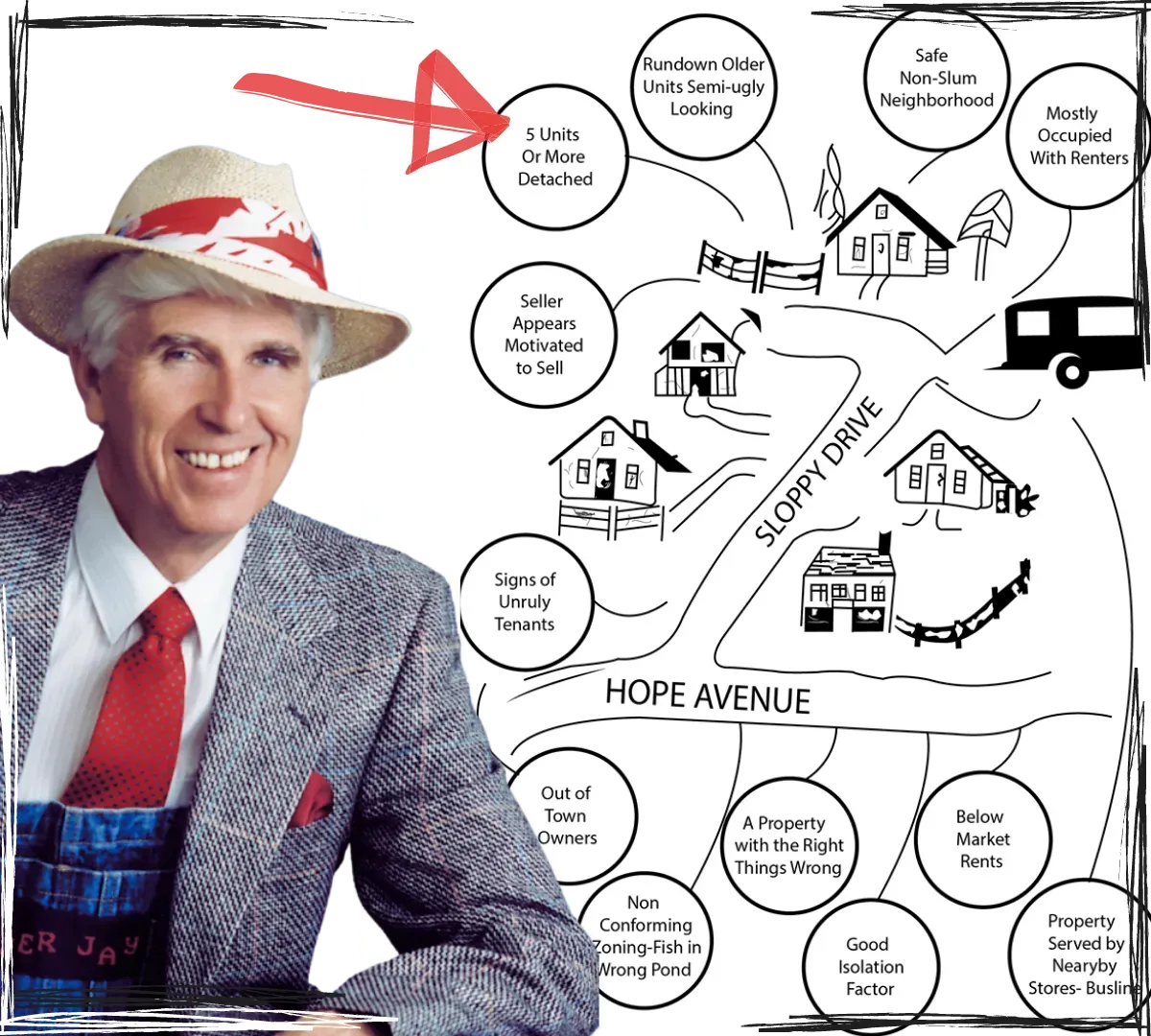
Finding the right properties with good potential for profits and cash flow is the first step for developing a successful investment plan. As you might guess – it’s important to break away from traditional thinking and the average investor crowd. Serious money is made by those who study the marketplace and have the ability to spot bargains that others simply don’t see. You don’t need to buy slaughterhouses in the slums, but you do need to develop good investment eyes. Quite often you’ll find the biggest rewards are off the! Beaten pathway.

Multiple oddball configurations are the kind of properties that many brand new investors won’t touch with a ten-foot pole. These are mostly older non-conforming type real estate. For example; “cluster houses” like my Haywood and Cherry Creek properties. I call them “leper properties”, meaning most investors don’t want to touch them. I own many properties with various building combinations such as a three-unit apartment building, surrounded by 4 cottages and a duplex. My Oregon Street property was an older 4 bedroom family house and a large 2-story duplex with a garage. The property was easy to convert to 5 rental units by making the garage into a 1-bedroom apartment and splitting off a bedroom and bath from the 4-bedroom house. A rear door entrance made the house conversion fairly inexpensive and of course created 5 separate rental units!

Obviously, my basic idea was to purchase three rental units at the regular 3-unit price, knowing all along I would be able to modify them and quickly start earning 5 units worth of income. Oregon Street was an extra special money-maker because the property was rundown and rents were abnormally low when I acquired it. With the conversion to 5 units _ plus my fix-up work, I was able to increase rents from $1000 monthly to $1900. The total job took me just over a year to complete. A short time later I sold the property for more than double the price I had paid.

Combination properties, like the kind I’m telling you about, all have several things in common. First of all, you won’t find them in newer subdivisions – even those built in the last 40 years. Leper properties can be found in the older sections of town or just outside the city limit sign. Today’s complex zoning la~ would obviously prohibit such construction. However, what’s already there today is “grand fathered” in, regardless of current zoning laws, so long as the buildings remain standing. By the way, age is not important so long as buildings are properly repaired and maintained. Many homes in Virginia and Georgia are 250 years old and they cost more today than brand new ones. On the other hand, I’ve seen eleven year old housing projects in Chicago condemned and torn down by the city. Only 11 years old and unfit for occupancy. They say! Believe me, age has very little to do with the condition of housing – or its value.

MY FIRST REQUIREMENT FOR INCOME PROPERTY IS INCOME

From an income standpoint, which I care most about, oddball units command the same rents as newer apartments, sometimes more because they generally offer more privacy. Another very important common attraction is that most older leper units have long been paid for! They have no commercial mortgages to mess with. More often than not. owners can finance the sale. That means, no credit applications, tax forms, loan fees, appraisals and variable rate bank loans. In summary, lower purchase prices, less competition and long-term owner financing are commonplace with these types of properties. If cash flow turns you on, my advice is start looking for leper properties today.


Click Here to Join Fixer Jay's Blog!