Entries Tagged as 'Houses with Highest Profit Potential'

CASH FLOW TRUMPS BEST LOCATION


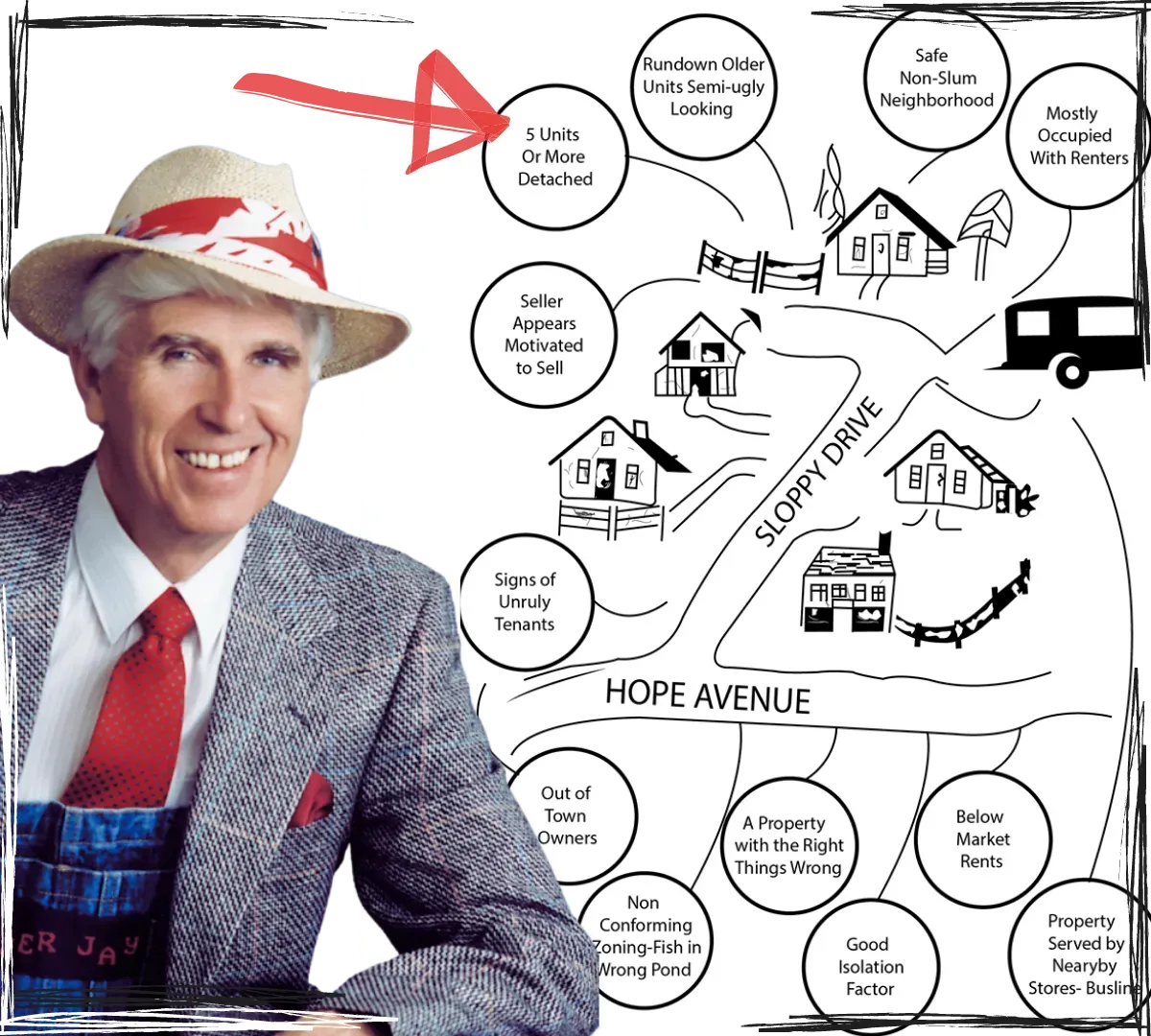
Not every property that looks run-down, ugly and distressed is a gold mine in dis­guise. In fact, if you were to purchase many of the so-called “fixer-uppers” chances are very good that you’ll end up with only the shaft. I’m not trying to slow down your ef­forts to buy diamonds in the rough. What I am trying to do is help you understand that there is more to it if you intend to make any serious money doing this stuff.


In my own efforts to find fixer properties that fit my investment criteria, I’m constantly looking for specific problems or condi­tions. I want to acquire properties that I can transform into positive money-makers. This transformation can be the property’s physical appearance or it can be a restructuring of its financial condition. Also quite common for me is changing (removing) the people who occupy the property. More often than not I’m doing all three types of transformations at the same time.


You don’t get big paydays simply because you own real estate. “

You don’t get big paydays simply because you own real estate. You earn big paydays from doing something that increases the value of real estate. A value increase doesn’t neces­sarily have to be a big change in the present market value. Even if a property doesn’t go up a nickel in market value but is made to produce more net income from rents, you’ve created some additional value.


As you search for investment properties, you must make your decision to pursue a deal or pass it up based on your knowledge of what you can do if you own the property. Many folks pass over solid money-makers because they don’t understand the various ways they can profit.


One of the most common examples I can offer is the case for buying only those houses without concrete perimeter foundations. That’s good sound advice as a general rule. However, there are some exceptions. I just happen to own quite a number of them. They produce the highest cash flow of all my houses. The reason is simple. I only paid about 50 percent of what equivalent houses with pe­rimeter foundations cost. As a result, the mortgage payments are only half as much.

However, the rents are about the same as ~y regular foundation houses. It’s the same Idea as buying mobile homes for rentals. You can buy them cheap and rent them for markups of two or three times higher than standard foundation houses.


I’m always concerned with location. I want good location for a specific plan I have in mind. However, all my plans are not the same. They all have the same objective – to make profit – but the way I do it can vary with different properties.


. Some houses are excellent long-term Investments. But don’t try to outguess the future. Don’t bet the ranch on your long­ term (10 years or more) predictions. It’s still Just a guess. With long-term investments in top locations, you can expect to pay more to acquire them. Even if the property looks terrible the competition will keep the price higher because of location.


On the down-side, higher acquisition costs and bigger mortgage payments can cost you a lot more money and take longer before you realize any profits or cash flow. This is important because mom and pop in­vestors need cash flow first and long term profits later on.


I like to think about locations as “A” “B” and “C”. “A” locations are the best. “B’: will be the local average and “C” is a stone’s throw from the county dump. With some study and driving around, you can easily determine these locations in your own in­vestment area. Investing in “A” locations is fine, but it generally takes more cash. My choice is “B” locations, but I always look at a “c” to make sure I don’t miss anything exciting. I stay away from HUD projects, high crime areas and places where I don’t feel safe being there.

STUDENT DAN UPS VALUE 62%

Some people try to avoid problems in their lives. However, I will suggest to you, that in the world of real estate investing, finding and solving problems can put money in your pocket. Remember, problems usually will cost the property seller a lot of money. However, as a buyer, problems can be disguised opportunities. These problems don’t need to be so big that you need engineers and heavy equipment operators to fix. You will be able to fix them for only a few dollars. These will be problems that others overlook or choose not to address.

FLAT ROOF, CLOGGED DRAIN, BAD FLOORPLAN AND A DUMP NEXT DOOR

How appealing does that sound to you? Well, I bought my Miller Street house with these problems. It was about 40 years old. It was listed as a 2 bedrooms, 2-bath home with an “extra room and bath in the rear”. It was vacant, and in OK, but dated, condition on the inside. It had a flat roof. Older houses in this area, with flat roofs, tend to get very hot inside during warm weather. The real estate agent also told me that the neighbors informed him that roots, from the big tree in the front yard, periodically clogged the main waste line.
Over the years, someone added a bedroom and a half bath to the back of the house. But the problem was that you had to go outside of the main house to get access to it. And finally, the house next door was a big eyesore- A REAL DUMP. It had piles of junk and old cars on the front lawn, the siding was falling off, roof shingles were missing, and it was painted an ugly rust color.
This house was actually listed with a real estate agent and had been on the market for 24 months when I first saw it. This is what you call a STALE LISTING in the real estate business. Agents had pretty much stopped showing it to clients. They just did not want to waste their time. Why did I want these problems? Because I could see the profit in it for me. I could fix and rent the house, problem-free, to a nice family. There were not expensive structural problems and the overall fix up costs seemed to be minimal. I figured that for $3,000 to $4,000 I could solve most of the problems with the house and make it more desirable and profitable. It was a simple home that had some challenging flaws. I knew that the low price of $55,000 for the house reflected these flaws and the fact that it had been on the market for 2 years. $3,000 increased the value of this simple rental house by about $35,000

Take Advice From Do’ers Not Wind Talkers

If you read about successful people, as I like to do, you’ll find that downturns in the economy or rough times at the bank have very little to do with their success.  In fact, most don’t even mention the economy or banks when they discuss what’s needed to be successful.  Reading autobiographies of successful entrepreneurs will give you an inside look about what it really takes to make it.  I would strongly suggest you read success stories because they help you to mentally rise above the “ho-hum” of everyday problems.

There’s a popular myth we’ve all heard — “It takes money to make money”. William Nickerson, author of the most widely read do-it-yourself real estate book: “HOW I TURNED $1000 INTO A MILLION DOLLARS”, Simon and Schuster (1959), started investing with only $1000 saved from his telephone sales job.  Nickerson calculated back in 1980, using an inflation adjustment formula, it would take about $2500 to start out like he did.

Today, 25 years later, Nickerson’s calculation may need to be doubled or tripled again; however, Nickerson was always quick to tell anyone who would listen: It doesn’t have to be your money, nor does it even need to be cash! Knowing what to do – and how to invest wisely is far more important than having the money to invest.

A PLAN FOR CASH FLOW IS FIRST PRIORITY

When I began buying investment properties, there was no question in my mind whatsoever about where I might find some extra money if my properties didn’t provide enough cash flow.  The answer was clear to me the day I started — I couldn’t! Even though my cash down payments were quite small, it was all the money I had.  I knew very well there was nothing left in my bank account to make up for monthly cash flow shortages.  The only funds I would have to pay my mortgages and expenses would be the money I took in each month from my renters.  Obviously, buying properties this close to the belt is both challenging and exciting.  There is little room for buying errors as you might well imagine.  You definitely need your cash flow plan worked out before you sign the deal!

What I’m suggesting here — For most of us, it makes more sense to buy cash flow properties with uncertain futures than to acquire high potential properties without enough cash flow to operate them today.  Future potential is great — Don’t get me wrong, but it’s still “Pie in the Sky”! In my view, the top three reasons for owning and operating income properties are INCOME, INCOME and INCOME — Everything else must fall in behind.

ACQUIRE AS MANY UNITS AS YOUR DOWN PAYMENT WILL BUY

Almost every investor I know has paid too much for income property.  It happens more frequently when we first start out.  There is almost no defense against paying “too much” at least once or twice.  I’ve done it more times than I care to admit.  However, in my case, buying multiple unit fix-up properties allowed me to add value and improve the income stream more quickly than if I had overpaid for non-fixer type properties.  By fixing up properties I was able to recover from my buying errors much faster because I could raise rents.  The best education in the world for understanding real values and what the true expenses are – is learned very quickly buying and operating you own properties.  I’m not talking about a single house here.  That’s not quite enough action for me.  I’ve found that multiple fixer-uppers often don’t require any higher down payments than a single house – yet the cash flow potential is many times greater.  Often they come with seller financing to boot!

INEXPENSIVE RENTALS PROVIDE GREATER CASH FLOWS

One of the major parts of my personal investment strategy, which has paid big dividends over the years, has been to acquire lower end (affordable) rental units. These properties provide me with “eating money” or cash flow. They are my biggest source of income today.  Inexpensive rental units provide a much bigger (return) or “bang for the investor’s buck”. They’ve always been my number one cash flow providers. Obviously, these properties won’t normally sell as rapidly as higher grade rentals or single-family houses.  However, I’m a firm believer in first things first!

Getting Started With Fixers

There are many good reasons why fixers are the perfect properties to begin a real estate investor career. However, leading the list is CASH FLOW. Fixer-houses by far offer the best opportunities for small-time investors, without much cash to spend, to acquire real estate with minimum down payments and still achieve cash flow quickly. No other real estate I know of will do that!

CASH FLOW QUICKLY

It is reasonable to expect – after paying an average of 10% down that one can create a positive cash flow property within a relatively short period of time after the purchase. Obviously, the time it takes will depend on many factors, such as how long does the fix-up take – how much market value is added to the property – and most certainly, the skills and aggressiveness of the fixer.

I have learned from experience – cash flow is much easier to achieve buying small multiple residential properties, such as 2 or 3 houses on a single lot, several duplexes with a house or two, or any combination of these cluster type properties. I own many properties from 5 to 8 living units each. They are excellent cash flow producers after a year or so my goal for a complete turn-around is 18 to 24 months. We’ll discuss this part and the reasons why later.

LESS COMPETITION

Anytime there are fewer buyers who want something and you are shopping that particular market, your odds for success are greatly increased. Competition is what drives up prices. Conversely, the lack of it holds them down. It’s difficult to purchase prime real estate at a discount or get any kind of a break on the terms. The reason: Too many buyers are willing to pay the asking price. Why would a seller need to discount?

There are basically only 2 methods to buy real estate at bargain prices!

Method #1

Situations where you are the only potential buyer who knows about the deal (no competition) and, the seller is willing to accept your offer and terms without seeking outside bids (offers) from anyone else.

Method #2

Where the public knows about a property that’s available but cannot visualize its potential value - like after it’s all fixed up. They are therefore not buyers – only lookers.

Most students who seek my advice are not yet sophisticated enough to be in the information loop where they can benefit from Method #1. I’ll show you several ways I make Method #1 work for me later on! However, two of the most common ways Method #1 is used is by licensed real estate agents who buy their own listings and by friends of probate attorneys who get a secret telephone call when an asset (real estate) needs to be disposed of quickly. In both cases, the public never knows about the deal. Private deals avoid competition – therefore, they don’t get bid-up in price!

Method #2 is how most of my students will buy real estate. We shall focus in a market where properties are for sale. They are even advertised and certainly known to many potential buyers. However, 95% of all the potential buyers (the competition) see ugly rundown houses as pure junk and not even worth the asking price. Most will not make and offer and those who do will totally alienate sellers by insulting them with “low-ball” offers. With 95% of the competition gone, the playing field is definitely tilted in our direction.

MOTIVATED SELLERS

Motivated sellers get that way for many reasons! Here’s a list of the most common – All except one, which we’ll tackle later:

A. Property owner loses his regular 8 to 5 job.

B. Family problems – mostly divorce or death.

C. Poor health – can’t work on property any longer.

D. Change of investment goals. Found better mousetrap.

E. Moving from area. Job transfers most common.
F. Retirement time – Ready to hang it up and go fishing.

When you read your local newspaper classifieds, as you should, you’ll see all of the various reasons listed above over and over again! OWNER MUST MOVE, POOR HEALTH FORCES SALE, GROUND FLOOR OPPORTUNITY, OWNER RETIRING, DIVORCE SPELLS – MY LOSS, BUT YOUR GAIN. These are typical classified wordings in the real estate “For Sale” sections of any sizable daily newspaper you care to look at. Obviously, the ads are written to persuade buyers how motivated the owners are to sell! Some ads are true – most are baloney. It’s impossible to tell about motivation from an ad. Still it’s a starting point.

You will need to make offers and have direct discussions with the seller before you can really determine a motivation level. One way to cut to the chase is to offer 50% of the asking price! If the seller doesn’t throw you out of the room – perhaps he’s really serious about selling.

Let’s tackle that one exception I mentioned above! Don’t look for this reason listed in classified advertising or any other sales pitch for that matter. You won’t find it! Fact is, the seller will do his darndest to hide this particular motivation! He is motivated because he is a failure. Chances are good he’s losing his shirt on the property if you can discover motivation of this kind, and if you have the ability to fix the problem, thereby relieving the seller of the mess he’s in, you’re in an excellent position to be richly compensated for your efforts.

I had exactly the same situation when I purchased Hillside Cottage. The sellers were going under water for the third time. I was the only lifeline available to them, and of course, in the end I richly rewarded for my problem-solving abilities.

Click Here to Join Fixer Jay's Blog!